
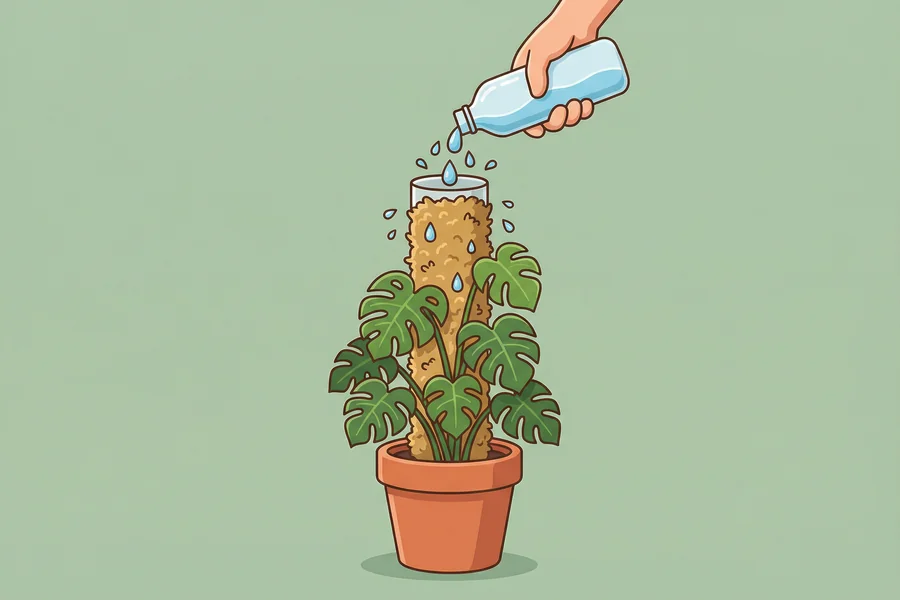
If you have ever decided to give your climbing houseplants—like Monsteras, Philodendrons, or Pothos—a moss pole to climb, you know the struggle. Setting it up is the easy part. The real challenge, and the question I get asked most often, is: how often should you water a moss pole? When I first started using sphagnum moss poles in my own home, I either left them bone dry or ended up overwatering my plants in an attempt to keep the moss moist. Over time, through trial and error, I have developed a solid routine that keeps my plants thriving without the constant stress of guessing.
In this guide, I will share my personal experience on how to tell when your moss pole is drying out, how often you really need to water it, and the most effective techniques to keep that moss perfectly hydrated without drowning your plant’s soil.
Why Keeping Your Moss Pole Moist Matters
Before we talk about frequency, it is important to understand why we are doing this. In the wild, climbing aroids use their aerial roots to attach to trees, drawing moisture and nutrients from the humid, mossy bark. When we introduce a moss pole indoors, we are trying to replicate that natural environment.
If the moss pole stays completely dry, it acts as nothing more than a physical stake. Your plant might lean on it, but the aerial roots will not grow into it. However, when the moss is consistently moist, those aerial roots will actively seek it out, embedding themselves deep into the sphagnum. This secondary root system is the secret to unlocking those massive, mature leaves and stunning fenestrations we all want.
Signs of Dryness: How to Tell Your Moss Pole Needs Water
There is no universal schedule for watering a moss pole because every home environment is different. Factors like your room’s temperature, ambient humidity, airflow, and the season all play a massive role. Instead of sticking to a strict calendar, I rely on a few clear signs of dryness.
1. The Touch Test: This is my go-to method. Every morning while I have my coffee, I do a quick walk-around. I simply press my fingers into the moss. If it feels crispy, crunchy, or rough, it is definitely time to water. Ideally, you want to water it when it feels just slightly damp, right before it goes completely bone dry. Sphagnum moss can become hydrophobic (water-repelling) if it dries out completely, making it incredibly difficult to rehydrate.
2. The Color Change: Sphagnum moss changes color based on its moisture level. When it is nicely hydrated, it usually has a rich, darker brownish-green or tan hue. As it dries, it fades to a much lighter, pale beige or almost white color. Usually, the top of the pole dries out first since water naturally travels downward.
3. The Weight Test: If your plant is still in a relatively small pot, you can gently lift it. A wet moss pole holds a surprising amount of water and will make the pot feel noticeably top-heavy. A dry pole feels light and airy.
So, How Often Should You Water It?
Based on my experience, in a standard indoor environment with average humidity (around 40–50%), I find myself watering my moss poles every 3 to 7 days. During the hot summer months when my plants are actively growing and drinking more, I sometimes have to top them up every 2 to 3 days. In the winter, when the heating is on but plant growth slows down, it might stretch to once a week.
The golden rule I follow is: never let the moss pole completely dry out. It is far better to keep it consistently damp than to let it cycle between soaking wet and bone dry. If you wait until it is entirely crispy, the water will simply run straight down the outside of the moss and flood your potting soil, potentially leading to root rot.
My Favorite Watering Techniques
Watering a moss pole without accidentally overwatering the soil in the pot is an art form. Over the years, I have tried just about everything, and here are the three methods that actually work in practice.
The Upside-Down Water Bottle (The Lazy Method)
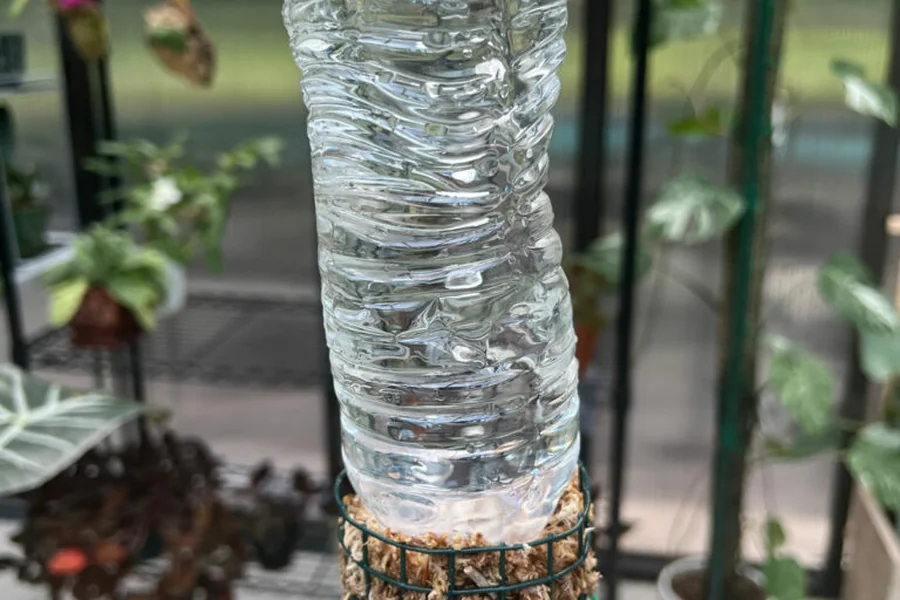
This is my absolute favorite trick, and it saves so much time. Take a standard plastic water bottle, fill it with water, and poke three or four tiny holes in the cap. Make a small indentation at the top of your moss pole, and invert the bottle so the cap rests in the moss. The water will slowly drip down, perfectly saturating the sphagnum moss over a few minutes without flooding the soil below. If you notice the water is not dripping, just squeeze the bottle slightly or make the holes a tiny bit bigger.
The Spray Bottle Method
If your moss pole is only slightly dry, a heavy misting with a spray bottle works wonders. This is great for daily maintenance. However, if the pole has gone completely dry, misting alone will not penetrate deep enough to reach the aerial roots inside.
The Kitchen Funnel
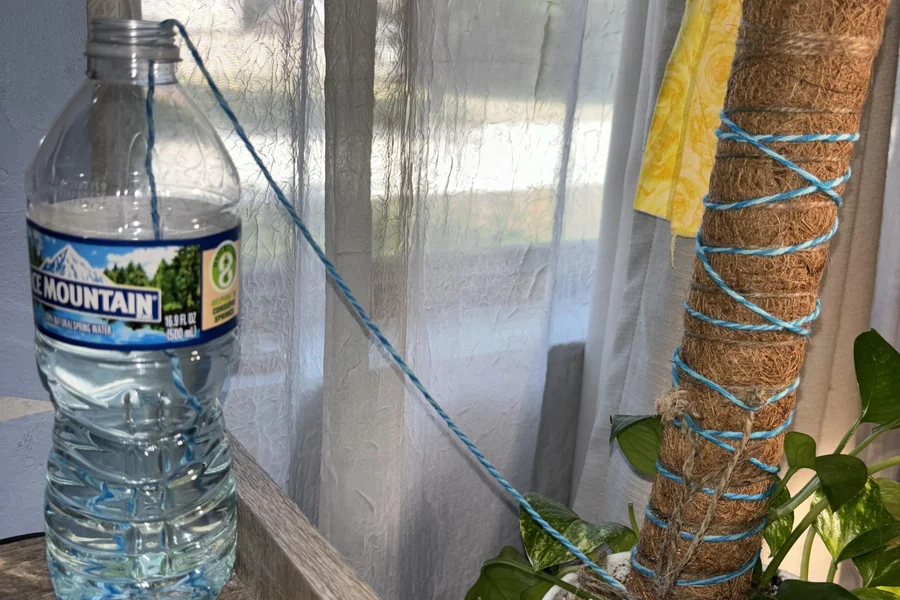
For larger poles, I sometimes use a kitchen funnel. I poke the spout into the top of the moss at a slight angle and slowly pour water in. This directs the water right into the core of the pole rather than letting it run down the sides.
Do You Still Need to Water the Soil?
This is a crucial point that many plant parents overlook. Just because you are watering your moss pole does not necessarily mean your plant’s main root system is getting what it needs.
If your plant is newly attached to the pole, you absolutely must continue watering the potting mix as usual. The plant relies entirely on its soil roots at this stage. However, once the plant is well-established and has a massive network of roots growing inside the moss pole, you can actually reduce how often you water the soil. I still check the potting mix regularly, but I often find that the runoff from watering the pole is enough to keep mature plants happy.
Quick Reference: Moss Pole Moisture Guide
| Condition | Indicator | Action Required |
|---|---|---|
| Perfectly Hydrated | Dark brown/green, damp to touch, heavy | Leave it alone; monitor daily |
| Slightly Dry | Top is lighter in color, feels less damp | Mist heavily or use slow-drip bottle |
| Bone Dry | Crispy, pale beige, repels water | Mist first to break surface tension, then soak slowly |
By keeping a close eye on the visual and tactile signs of dryness, and utilizing slow-watering techniques like the water bottle method, you can maintain a perfectly moist moss pole year-round. Your climbing plants will reward you with stronger growth, larger leaves, and a much healthier root system overall.
