

Why It Can Be Illegal to Propagate Some Plants
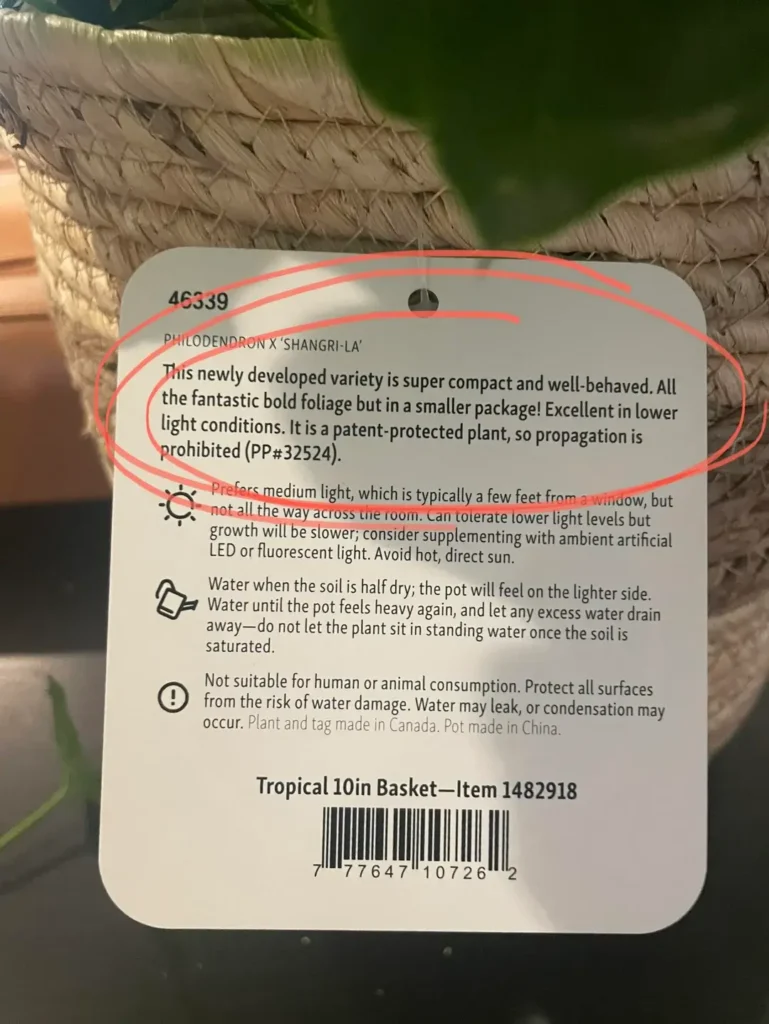
If you’ve been into plants for a while, you’ve probably had this moment: you bring home a beautiful new variety, admire the foliage, turn the label over – and find a line in small print that says something like “Propagation prohibited” or “Asexual reproduction is illegal.”
For many people, that feels almost absurd. Gardening is built on sharing: passing cuttings between friends, dividing clumps of perennials, saving seeds from your favourite tomato. How can something as ordinary as taking a cutting be against the law?
The short answer is that there isn’t just one reason. Some plants are protected because they are the result of years of expensive breeding work. Some are protected because they’re endangered in the wild, or because trading them drives poaching. Others are restricted because they are invasive, or because they can carry pests and diseases across borders, or in a few cases because they are tied to controlled substances or toxic compounds.
On the surface, a “do not propagate” tag looks like it’s telling you what to do with your own pot. Underneath, it’s sitting on top of several overlapping legal systems: intellectual property law, conservation law, biosecurity regulations and, in niche cases, drug or poison control rules. Understanding those systems is the key to making sense of why propagating some plants can be illegal – and to gardening in a way that is both safe and ethical.
For examples of common exceptional breeding varieties, please click to view this article: Common Plants That Are Often Illegally Propagated
Owning a Plant Is Not the Same as Owning the Right to Copy It
A useful place to start is with a comparison outside the plant world. When you buy a book, you are buying a copy of the work. You can read it, lend it, scribble notes in the margin. But you do not automatically get the right to print 10,000 copies and sell them. That right is reserved to the author or publisher by copyright law.
Something similar exists for plants. When you pay for a patented or protected variety, you are purchasing individual specimens. You do not automatically gain the legal right to reproduce that variety.
In gardening terms, “reproduce” usually means asexual propagation – making clones. Seeds are a bit more complicated (we’ll come back to that), but most of the familiar methods we use at home fall squarely into the “cloning” category: cuttings, divisions, offsets, grafting, air-layering, root cuttings, tissue culture. From a legal point of view, it does not matter whether you stick the cutting in a high-tech mist bench or a jam jar of water on your kitchen windowsill. If a plant is covered by a plant patent or plant breeder’s right, any deliberate act to create a new plant genetically identical to the original can be considered propagation.
That doesn’t mean “the plant police” are about to knock on the door of every person who rooted an extra stem of a houseplant. In practice, enforcement focuses overwhelmingly on commercial-scale offenders. But the letter of the law is still there, and that’s why the warning sits on the label.
Plant Patents, Variety Rights and the Business Behind New Plants
Modern horticulture is full of branded series and named varieties: roses that flower non-stop, hydrangeas with unusual colours, petunias that trail perfectly out of a hanging basket, or the latest variegated houseplant that seems to be everywhere on social media. It’s easy to forget that behind those pretty leaves is a lot of work – and a lot of risk.
Breeding a new variety usually takes years. A breeder might cross hundreds or thousands of plants, select the few that have the right combination of traits, test them in different climates, check that they remain stable across generations, and make sure they don’t have hidden weaknesses. All of that happens before a single plant ever reaches a garden centre bench.
Plant patents and plant variety rights exist to make that investment survivable. In the United States, a plant patent can be granted for a new plant that is reproduced asexually and is distinct and stable. For around twenty years from the filing date, the patent holder has the exclusive right to control that variety’s asexual propagation and sale. In many other countries, a parallel system called Plant Breeder’s Rights or Plant Variety Protection gives breeders similar control, often for a set number of years depending on the crop.
This is where the familiar phrases on labels come from: “PP#12345”, “PPAF” (plant patent applied for), “U.S. protected variety”, “Unauthorized propagation prohibited.” They are not simply stern warnings dreamt up by marketing departments; they reflect an underlying legal status. When growers buy young plants of a protected variety from a licensed supplier, a portion of the price is a royalty fee that flows back to the breeder. If another nursery quietly takes cuttings from those plants and sells the results without permission, it undercuts that system.
There have been real cases where companies were fined heavily for doing exactly that: rooting cuttings of patented roses or branded annuals, selling thousands of clones, and skipping the royalties. The damages can run into hundreds of thousands of dollars. These disputes rarely involve hobbyists; they usually target businesses that propagate plants on a commercial scale. But the same law is what the little “do not propagate” tag is pointing to when you bring a plant home.
On top of patents and breeder’s rights, there is another layer: trademarks. A cultivar might have a technical name like Hydrangea macrophylla ‘Bailmer’, but be sold to the public under a trademarked series name like Endless Summer®. Even after a patent or breeder’s right expires, that brand name can remain protected. In practice, that means that a very old variety might be free to propagate, but you still cannot market your plants under the original registered brand.
For a home gardener, the key idea is not the fine print of each law, but the principle: some modern plants exist because breeders can recoup their investment, and those legal tools are how they do it. The tag is there to remind everyone not to bypass that system by making clones without permission.
Conservation, Poaching and the Trade in Rare Plants
Not all restrictions on propagation are about protecting breeders’ work. In other cases, the law is trying to protect wild plants from us.
Across the world, wild populations of many attractive species have been hammered by habitat loss, climate change and direct collecting. Rare succulents in South Africa and Namibia, wild orchids in Southeast Asia and Central America, carnivorous plants in bogs, cycads that have survived for centuries – all of these have been taken from the wild and pushed closer to extinction, in part because collectors are willing to pay high prices.
Most countries now have laws that protect certain native plants. It may be illegal to dig them up, to possess wild-collected specimens without permits, or to sell them. On top of that, the international convention known as CITES (the Convention on International Trade in Endangered Species of Wild Fauna and Flora) controls cross-border trade in many endangered plants. Orchids, cacti, succulents, cycads and others appear on its appendices. Exporting or importing them without the correct paperwork can be a criminal offence, even if the plants were produced in a nursery.
Where does propagation fit into this? In several ways. First, if a wild plant is protected, taking it, propagating it and then selling the offspring does not magically erase the illegal origin. Second, the ability to clone desirable wild plants easily can actually fuel poaching: someone steals a few hundred rare succulents from a remote hillside, propagates them in large numbers, and floods the market while advertising them as “nursery grown”. Third, some legal frameworks also regulate the propagation of protected plants unless you have a licence, because authorities want to keep track of how many plants are moving around and where they come from.
From a gardener’s perspective, the simplest rule is this: if you are dealing with a rare plant that may be endangered in the wild, it is worth asking where it came from. Was it legally propagated from documented nursery stock, or is it part of an opaque trade that puts more pressure on wild populations?
Invasive Species and Biosecurity: Plants That Are Too Good at Surviving
At the opposite end of the spectrum are plants that are not in danger of disappearing at all. In fact, they are so good at spreading that they can overrun native ecosystems, clog waterways, choke forests or destroy agricultural land.
In many regions, governments maintain lists of invasive species and noxious weeds. Once a plant is on that list, various restrictions can kick in: it may be illegal to sell it, to transport it, to plant it, and in some cases to deliberately propagate it at all. Well-known examples in different parts of the world include Japanese knotweed, water hyacinth, purple loosestrife, Himalayan balsam, kudzu and others. Some are still admired in gardens in one region while being tightly controlled in another.
Here again, propagation is at the heart of the problem. A single cutting dumped in a waterway can start a new infestation of an aquatic weed. Garden waste tipped at the edge of a woodland can spread invasive groundcovers. Even a small number of seeds moved on muddy boots, pets or vehicles can slowly shift a plant from gardens into wild habitats.
Alongside these invasiveness rules, there are plant health and quarantine systems designed to stop pests and diseases moving across borders. Agencies such as USDA-APHIS in the United States, or national plant health authorities in Europe and elsewhere, restrict which plants, cuttings, seeds and even soil can be imported or moved between regions. Some species are outright banned; others require inspections, plant passports or phytosanitary certificates.
For a home gardener ordering plants or cuttings online from another country, that means the issue is not just what you propagate, but where it came from and where it is going. A cutting that looks perfectly harmless might be carrying an insect or a fungus that does not yet exist in your region.
Controlled and Toxic Plants: The Niche Cases
Finally, there is a smaller set of plants caught up in laws for reasons that have nothing to do with horticulture as such. Some species are controlled because they contain psychoactive compounds, or because they can be used to produce illegal drugs, or because they are considered dangerously toxic. The details vary widely between jurisdictions. In some places, certain ornamental poppies or Datura species are restricted; in others they are not. Sometimes the law focuses on extraction and processing of compounds rather than on the plants themselves.
These cases are relatively rare in everyday ornamental gardening, but they are a reminder that propagating plants touches more than one area of regulation. If a plant is strongly associated with drug use or poisoning, it is sensible to check local law before planting or sharing it.
What This Means for Everyday Gardeners
All of this can sound rather heavy for people who just want to enjoy plants. But in practice, staying on the right side of both the law and your own ethics comes down to a few habits of mind.
The first is simply paying attention to labels and origins. If a plant carries clear warnings like “Propagation prohibited,” “PPAF,” “protected variety,” or a plant breeder’s rights logo, then treat it as something you enjoy as-is. You can grow it, shape it, care for it – but don’t start a little informal cutting factory, even for friends, and certainly not for sale.
The second is being cautious with “mystery material”. It has become fashionable in some online communities to “proplift” – to pick up broken or fallen pieces of plants in shops or public places and root them. Leaving aside the ethics of taking something that does not belong to you, those pieces may be from patented varieties or rare plants whose origin you cannot verify. The safest, cleanest approach is to ask permission or buy a plant outright, not quietly gather fallen parts.
The third habit is to think about ecology as well as legality. If you garden in a region where certain species are classed as invasive, it is worth learning their names and not actively spreading them. If you are tempted by extremely rare wild plants, ask yourself whether your purchase will help support ethical nurseries and conservation or quietly encourage poaching.
The fourth is to remember that there are countless plants you can propagate freely. Old heirloom varieties, species that have never been patented, plants whose protection has expired, and ordinary non-invasive ornamentals all provide endless material for sharing. Many breeders also voluntarily release varieties into the public domain or offer open licences that allow propagation under certain conditions. If you love the act of propagating, there is no shortage of material that does not carry legal or ethical baggage.
A Different Way of Looking at “Propagation Prohibited”
It’s easy to see the small line on a label as something hostile: a company telling you what you can and cannot do with “your” plant. But if you zoom out a little, those words are part of a broader attempt to balance several things at once:
- Encouraging breeders to invest in new and better plants
- Protecting wild populations from being stripped for collectors
- Preventing aggressive species from wrecking ecosystems and economies
- Keeping pests and diseases from hitchhiking across borders
- Controlling a few plants that intersect with drugs or poisons
None of these systems is perfect. They can be slow, inconsistent or unevenly enforced. But they all come from the fact that plants are not just decorations in pots; they are living organisms that sit inside economic, legal and ecological webs.
If you are the sort of person who worries, “Am I allowed to propagate this?”, you are already ahead of the curve. You are treating plants not as disposable objects, but as part of a network of responsibilities. The next step is simply to be a little more curious: read labels, ask nurseries about rights and origins, learn the invasive species in your region, and support growers who do things properly.
Propagation will always be one of the most satisfying parts of gardening. Understanding when and why it is restricted does not take away that joy; it gives it more depth. You are no longer just multiplying leaves and stems. You are participating, consciously, in the long, complicated relationship between humans and the plants we depend on.
Further reading
- USPTO – General information about U.S. plant patents and 35 U.S.C. §161.
- USDA Plant Variety Protection Office – overview of plant variety protection.
- University of Vermont Extension – plain-language explanation of plants and intellectual property.
- CITES official site – appendices and guidance on trade in endangered plants.
- USDA-APHIS – plant protection and quarantine information (import and movement of plants).
- Articles on illegal succulent poaching and the trade in wild plants, e.g. recent reporting on Conophytum trafficking.
