
Hoya Carnosa vs Hoya Compacta: Choosing the Right Wax Plant for Your Space
For indoor plant lovers and beginner gardeners alike, Hoya carnosa and Hoya compacta stand out as two of the most visually captivating and easy-care houseplants. Often grouped together due to their shared genus—Hoya—and their glossy, wax-like leaves (hence the nickname “wax plants”), these two varieties can appear remarkably similar at first glance. However, a closer look reveals notable differences that impact their care, appearance, and suitability for different living spaces.
Both plants are prized for their trailing vines, thick succulent leaves, and clusters of fragrant, star-shaped flowers. Still, their differences in form, growth habit, and maintenance needs make them suitable for different plant parents. Whether you’re a seasoned collector or just starting your indoor jungle, understanding the distinctions between Hoya carnosa and Hoya compacta will help you choose the right green companion for your home.
Side-by-Side Comparison Table: Hoya Carnosa vs. Hoya Compacta
| Feature | Hoya Carnosa | Hoya Compacta |
|---|---|---|
| Botanical Name & Family | Hoya carnosa (Apocynaceae) | Hoya carnosa ‘Compacta’ (Apocynaceae) |
| Native Region | Eastern Asia (India, China, Malaysia) | Cultivar of Hoya carnosa; not naturally occurring |
| Leaf Shape & Size | Flat, ovate leaves; 5–8 cm long | Deeply curled, twisted leaves; 3–7 cm |
| Growth Habit & Speed | Fast-growing vine under ideal conditions | Slower growth due to dense, twisted form |
| Stem Structure / Identifiers | Smooth vines; leaves grow opposite along stem | Thick, rope-like vines; leaves tightly clustered |
| Light Requirements (Lux) | Bright indirect light; thrives in 10,000–25,000 lux | Bright indirect light; tolerates 8,000–20,000 lux |
| Watering & Humidity | Allow soil to dry halfway; prefers 40–60% humidity | Drier conditions preferred; 30–50% humidity |
| Pet Safety / Toxicity | Non-toxic to pets (ASPCA) | Non-toxic to pets (ASPCA) |
| Typical Price / Availability | Widely available; more budget-friendly ($10–$25) | More expensive due to demand ($20–$50+) |
Key Differences Explained: What Sets Them Apart
1. Visual Identity and Leaf Shape
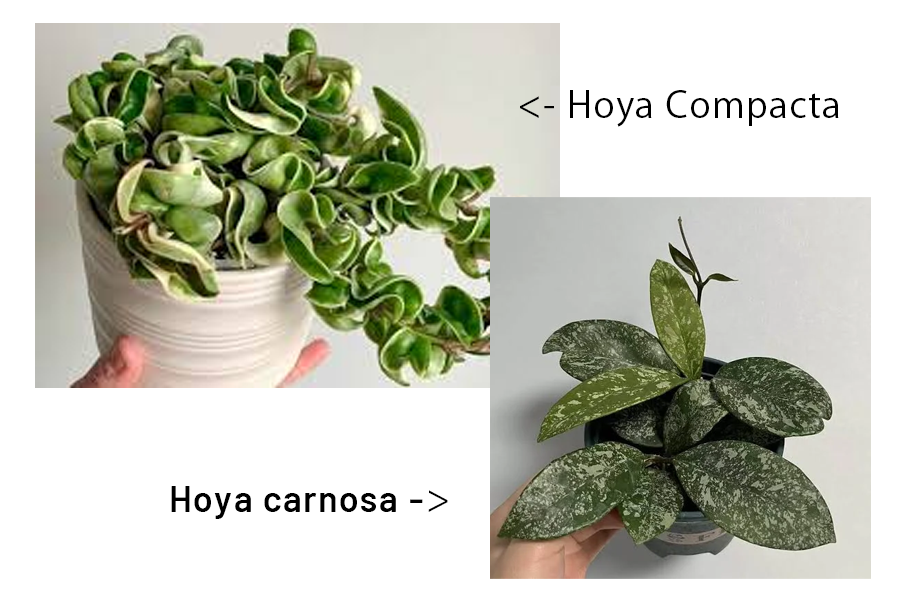
The most noticeable difference between Hoya carnosa and Hoya compacta is their foliage. Hoya carnosa displays smooth, medium-green, and sometimes speckled leaves with a flat, classic oval form. It’s the kind of foliage that can blend in with a variety of décor styles, providing a clean and polished look. On the other hand, Hoya compacta, often referred to as the Rope Plant or Hindu Rope, is famous for its heavily contorted, tightly curled leaves that spiral along thick vines. Because of this dense, sculptural appearance, the compacta variety often serves as a conversation piece and a statement plant.
2. Growth Rate and Care Difficulty
Hoya carnosa grows significantly faster than its compacta cousin. It can put out long vines several feet in a year under good light and watering conditions. In contrast, Hoya compacta is considered a slow grower—the dense curling of its leaves slows down the photosynthetic process, naturally limiting its pace. For this reason, new growth and flowering are harder to achieve with compacta, making it a bit less rewarding for impatient beginner gardeners. Additionally, its twisted leaves can make regular pest inspection more difficult, increasing care demands slightly.
3. Space and Suitability
Hoya carnosa’s more open and trailing vines make it ideal for hanging planters, vertical trellises, or large wall arrangements. It occupies more linear space, often cascading gracefully down from shelves. In contrast, Hoya compacta requires far less vertical real estate, growing in tight coils that can hang down heavily or cluster together. This makes the compacta variety a better fit for small apartments or tighter shelving areas where floor or wall space is limited.
4. Water Retention and Root Issues
Because of its tightly packed leaves, Hoya compacta has a reputation for trapping water within its folds. This creates pockets where moisture can linger, raising the risk of fungal issues or mealybug infestations if overwatered. In contrast, Hoya carnosa’s more open structure promotes faster drying. Both plants are semi-succulent and should not be overwatered, but beginners may find Hoya carnosa less finicky in this regard.
Which One Should You Choose?
Both Hoya carnosa and Hoya compacta offer the benefits of striking appearance, moderate care needs, and pet safety. But depending on your lifestyle, space, and experience level, one may be a better match than the other.
- Best for Beginners: Hoya carnosa. It’s more forgiving with watering lapses, grows faster, and adapts easily to a range of indoor conditions.
- Best for Small Apartments: Hoya compacta. Its compact, draping form makes it ideal for constrained spaces, such as closet shelves or narrow bookcases.
- Best for Statement Décor: Hoya compacta. Few houseplants match the sculptural drama of its twisted foliage and dense vine structure.
- Best for Low to Medium Light Homes: Hoya carnosa. While both need bright indirect light, carnosa tolerates lower light better and responds more naturally to indoor lighting.
- Best for Pet-Friendly Households: Both! According to the ASPCA and other verified resources, these Hoyas are non-toxic to dogs and cats, making them worry-free choices for animal lovers.
Conclusion
Hoya carnosa and Hoya compacta may appear closely related—and they are—but their distinctions in foliage, growth patterns, and maintenance requirements offer vastly different experiences for plant lovers. Hoya carnosa is the friendlier, fast-growing climber, ideal for those looking to fill space and enjoy regular growth. Hoya compacta, meanwhile, is the more exotic, densely wound variety perfect for artistic home design and compact living. No matter which you choose, both provide enduring beauty and unique charm as part of any indoor garden.
References
- American Society for the Prevention of Cruelty to Animals (ASPCA). (2023). Toxic and Non-Toxic Plants List – Dogs and Cats. Retrieved from https://www.aspca.org/pet-care/animal-poison-control/toxic-and-non-toxic-plants
- Brickell, C. (2019). RHS A-Z Encyclopedia of Garden Plants (4th ed.). Dorling Kindersley.
- Pell, S. K., & Watson, M. W. (2010). Hoyas: Climbing plants for topiary and hanging baskets. The Subtropical Gardener, 12(3), 20–25.
