
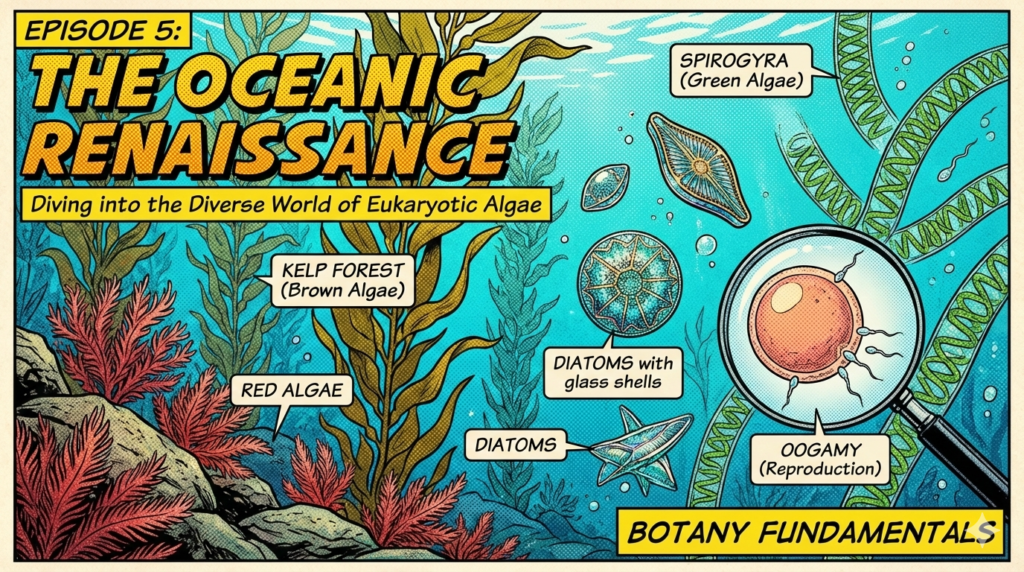
The Oceanic Renaissance: Diving into the Diverse World of Eukaryotic Algae
From Microscopic Jewels to Giant Underwater Forests—How the “Hardware Upgrade” of Eukaryotic Cells Conquered the Waters.
Introduction: The Great Hardware Upgrade
In Episode 4, we met the Prokaryotic pioneers—the simple yet powerful Bacteria and Cyanobacteria. But about 1.5 to 2 billion years ago, life received a massive “hardware upgrade.” This gave rise to the Eukaryotic Algae . Unlike their prokaryotic cousins, these organisms boast a true nucleus, membrane-bound organelles, and complex chloroplasts.
While they may look like “plants,” most botanists classify them as Thallophytes . Why? Because they lack the complex organs we see in land plants—no true roots, stems, or leaves. However, they are the undisputed “OG influencers” of the aquatic food web, producing over 50% of the Earth’s oxygen.
I. The Blueprint: General Characteristics of Algae
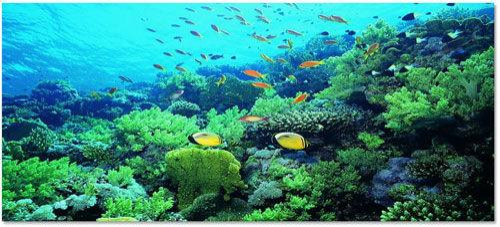
What makes an alga an alga? Beyond being eukaryotic and photosynthetic, they share several fascinating traits that allow them to thrive from polar ice to tropical reefs.
- Body Form: Their structure ranges from single-celled “lone wolves” (like Chlamydomonas) to colonial “socialites” (like Volvox) and massive multicellular “giants” (like Kelp).
- Photosynthetic Hardware: They contain Chlorophyll a, but depending on the group, they carry “accessory pigments” like carotenoids or phycobilins, which allow them to absorb light at various depths.
- Nutrition: Most are autotrophic, but some are “mixotrophs”—they can photosynthesize when light is available but “eat” organic carbon when it’s dark. Talk about versatility!
II. The Art of Algal Romance: Reproduction Strategies
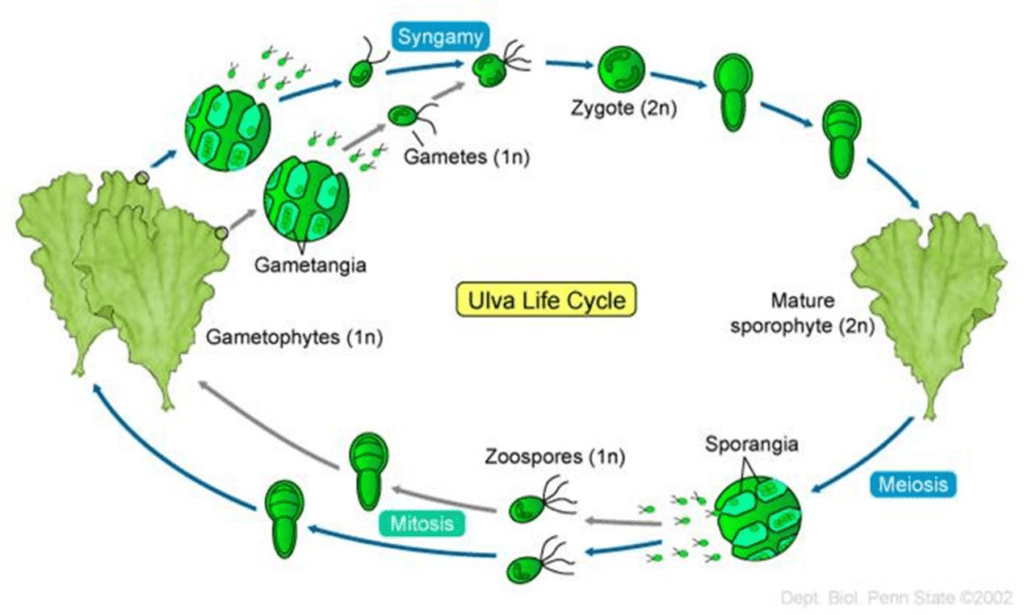
One of the most complex parts of algal biology is how they ensure the next generation survives. According to the data, they use a triple-threat strategy:
- Vegetative Reproduction: Simple fragmentation—the body breaks, and each piece grows into a new individual.
- Asexual Reproduction: The production of specialized spores, such as Zoospores which use flagella to swim through the water to find new territory.
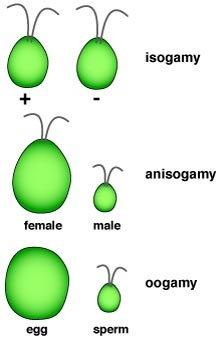
- Sexual Reproduction: This is where it gets interesting. Evolution shows a clear progression here:
- Isogamy : Gametes look identical. It’s like two twins meeting.
- Anisogamy : One gamete is slightly larger and less active than the other.
- Oogamy : The most advanced form. A large, non-motile Egg is fertilized by a small, fast-swimming Sperm. This is the method land plants (and humans!) eventually adopted.
III. The Big Three: Chlorophyta, Phaeophyta, and Rhodophyta
The algal kingdom is divided into several “clubs” based on their pigment and storage chemistry.
1. Chlorophyta (Green Algae): The Land Plant Ancestors
Green algae are the closest relatives to land plants. They store energy as starch and have cell walls made of cellulose.
- Chlamydomonas : The “lab rat” of algal biology—a single cell with two flagella and a red “eyespot” to sense light.
- Spirogyra : Famous for its beautiful spiral-shaped chloroplasts.
- Volvox : A hollow sphere made of thousands of cells working together—the first step toward multicellularity.
2. Phaeophyta (Brown Algae): The Ocean’s Skyscrapers
These are almost exclusively marine and include the giants of the sea. They get their color from a pigment called fucoxanthin.
- Laminaria : A staple in many diets, rich in iodine.
- Sargassum : Forms massive floating “forests” in the Atlantic, providing habitat for sea turtles.
3. Rhodophyta (Red Algae): The Deep Divers
Red algae can live deeper than any other photosynthetic organism thanks to phycoerythrin, which absorbs blue light (the only light that reaches the deep).
- Porphyra : If you love sushi (Nori), you’ve eaten red algae!
- Agar & Carrageenan: Extracted from red algae, these are used as thickeners in everything from ice cream to laboratory petri dishes.
IV. The Architects in Glass: Bacillariophyta (Diatoms)
No discussion of algae is complete without Diatoms. These single-celled organisms are nature’s tiny jewelers. They build their cell walls out of silica (glass), creating intricate, symmetrical shells called frustules.
They are so abundant that when they die, their glass shells sink to the ocean floor, forming “diatomaceous earth.” This material is used in everything from toothpaste to pool filters. Diatoms are also the primary “carbon sinks” of our oceans, playing a massive role in global climate regulation.
V. Economic and Environmental Impact: The Good and the Bad
Algae aren’t just biological curiosities; they are a multi-billion dollar industry and an environmental powerhouse.
- Food Security: Algae are rich in proteins, vitamins, and minerals.
- Red Tides : On the flip side, when certain algae (like Dinoflagellates) multiply too quickly due to pollution, they create “blooms” that release toxins, killing fish and making shellfish dangerous to humans. This is a major focus of environmental monitoring today.
Your Next Step in the Green World
From the microscopic glass boxes of diatoms to the massive kelp forests, eukaryotic algae show us the incredible flexibility of life in water. They perfected the “Oogamy” reproduction method that allowed plants to eventually leave the water and walk—or rather, grow—on land.
