
The O.G. Architects: Meeting the Prokaryotic Pioneers of the Living World
Beyond the Nucleus: Exploring Bacteria and Cyanobacteria—The Microscopic Warriors That Reshaped Earth’s Atmosphere.
Introduction: The Ancient Micro-Warriors
In our previous episodes, we marveled at the complexity of eukaryotic plant cells and the sophisticated tissue systems they form. But to truly understand botany, we must travel back in time to meet the ancestors. Long before the first leaf unfurled, the Earth was ruled by Prokaryotes.
The term Prokaryote refers to organisms that lack a membrane-bound nucleus and complex organelles. In the traditional “Two-Kingdom” system, these were often grouped with plants, but modern biology places them in their own distinct realms: the Kingdom Monera (or split into Bacteria and Archaea). Today, we focus on the two giants of this world: Bacteriophyta (Bacteria) and Cyanophyta (Blue-green algae).
I. Bacteriophyta: The Invisible Shape-Shifters
Bacteria are the ultimate “invisible influencers.” They are unicellular, possess a cell wall, lack photosynthetic pigments, and are found in almost every environment on the planet. Their simplicity is their strength, allowing for a high surface-area-to-volume ratio which powers rapid metabolism and reproduction.
1. Morphology and Size: The Big Three
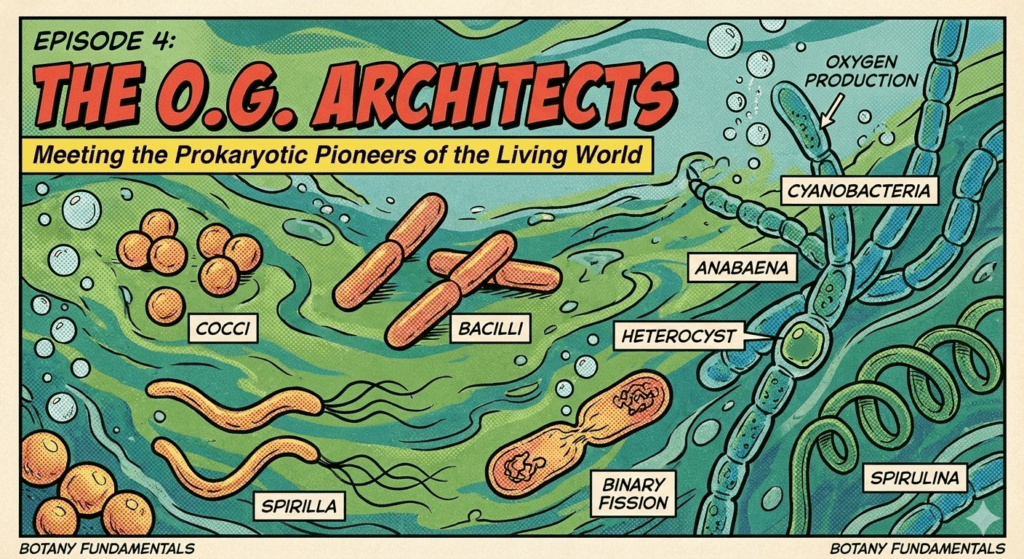
Bacteria are incredibly tiny, typically measuring only about 0.5 micrometers in diameter and 2-3 in length. Despite their size, they follow three iconic shapes:
- Cocci : Spherical “ballers” that can live alone or in clusters.
- Bacilli : Rod-shaped powerhouses, often seen in SEM (Scanning Electron Microscope) images as tiny capsules.
- Spirilla : Elegant, spiral-shaped cells.
2. Structure and Life Cycle
A bacterial cell is a minimalist masterpiece. It consists of a Cell Wall, Cytoplasm, and a Nucleoid (the region containing the DNA, without a surrounding membrane). They reproduce primarily through binary fission , a form of asexual reproduction so efficient that a single bacterium can create a massive colony in just hours.
II. Cyanophyta: The Blue-Green Revolutionaries
If bacteria are the builders, Cyanophyta (Cyanobacteria or Blue-green algae) are the energy disruptors. They are the oldest photosynthetic organisms, and they changed Earth’s history by producing the oxygen we breathe today.
Cyanobacteria are prokaryotic, yet they contain Chlorophyll a and Phycobilins (blue and red pigments), giving them their signature blue-green hue. Unlike “true” plants, their pigments are not housed in chloroplasts but are distributed on specialized internal membranes called thylakoids.
Key Cellular Features:
- Protoplast Division: Their cell is divided into a colored outer region (Chromoplasm) and a colorless inner region (Centroplasm/Nucleoplasm).
- Storage: They store energy as Cyanophycean starch.
- Gliding Movement: Many lack flagella but can move using a mysterious gliding motion.
III. The Hall of Fame: Representative Genera
Cyanobacteria aren’t just a green soup; they exhibit fascinating variety in form and function. Let’s look at some “celebrities” :
- Chroococcus : Simple single cells or small colonies encased in a thick, visible mucilaginous sheath .
- Microcystis : Known for forming irregular colonies. These are the culprits behind water blooms . When they multiply excessively in lakes, they can release toxins and deplete oxygen, posing a major threat to water quality.
- Oscillatoria: Filamentous structures that exhibit a unique oscillating or “dancing” movement. They lack heterocysts and spores.
- Spirulina : A spiral-shaped filament that has become a global superfood celebrity due to its high protein and nutrient content.
- Anabaena : These filaments are remarkable because they contain Heterocysts —specialized cells designed for nitrogen fixation. They turn atmospheric nitrogen into a form plants can use, acting as natural fertilizers.
IV. Prokaryotes and the Future of Botany
Why do botanists study these ancient micro-warriors? Because they are the ultimate bio-engineers. Cyanobacteria’s ability to fix nitrogen and perform photosynthesis in extreme conditions makes them central to sustainable agriculture and climate change research. Furthermore, the Endosymbiotic Theory suggests that the chloroplasts in every leaf on Earth today actually originated as ancient cyanobacteria that moved inside larger cells billions of years ago.
Your Next Step in the Green World
From the nitrogen-fixing power of Anabaena to the nutrient-rich spirals of Spirulina, prokaryotes prove that complexity isn’t always a requirement for global impact. They laid the foundation for the oxygen-rich world we live in.
Join us in Episode 5 as we step up the evolutionary ladder to explore Eukaryotic Algae—the true “ancestors” of land plants, where we meet the diverse world of green, red, and brown seaweeds!
